
Neuroinclusion is a major international opportunity for UK events.
In May 2026, the Academy of Management announced it was pulling its annual conference out of the United States until at least 2031 because members raised concerns about inclusion, accessibility, and whether international delegates would feel safe and able to participate fully. Four consecutive conferences — Vienna 2027, Toronto 2028, Frankfurt 2029, and London 2030 — will now take place outside North America, redirecting 13,500 delegates a year and tens of millions in hotel, restaurant, and tourism spend toward destinations perceived as more welcoming and accessible.
This isn’t an isolated example. A petition to move the International Congress of Mathematicians from Philadelphia this summer gathered more than 2,300 signatures over similar concerns. International associations and professional bodies are increasingly treating inclusivity as a site-selection criterion. The destinations and venues taking it seriously are winning business. The ones that aren’t are losing it.
This is a major opportunity for venues in the UK, Ireland, and across Europe.
What Copenhagen proved
The Academy of Management’s decision wasn’t made in a vacuum. It was accelerated by what happened in Copenhagen in 2025, when the organisation hosted its first-ever conference outside North America.
The result was the most globally diverse participant pool in the organisation’s 89-year history. As AOM President Tammy Madsen put it: “Copenhagen showed us what AOM looks like when we remove barriers that impact participation, and we intend to build on it.”¹
The lesson here isn’t really about geography. It’s about what happens when barriers are genuinely removed. When more people can comfortably participate — whether because the environment is less overwhelming, the registration process is clearer, or the networking structure feels more accessible — attendance grows. Diversity improves. And ultimately, the event becomes more commercially valuable.
A market the industry is largely ignoring
Around 20% of the population is neurodivergent, and there is already a commercial cost to not being neuroinclusive.
The spending power attached to inclusion is substantial. The Purple Pound — the collective economic value of disabled and neurodivergent people and their households — forms part of a wider disability market estimated at £274 billion annually in the UK.² In tourism and hospitality alone, domestic overnight visitor spending by trip parties including someone with a disability or impairment reached £5.8 billion in 2024, with a further £8.2 billion in day visits.³
Yet much of the events industry still overlooks the barriers neurodivergent attendees face. These barriers are rarely physical. They’re sensory, cognitive, and structural: overwhelming registration systems, unpredictable environments, networking formats that reward extroversion, or schedules that leave no space to decompress. Venues and event organisers can address most of these with little or no cost, making neuroinclusion one of the best pound-for-pound investments you can make.
As the Liverpool City Region Destination Partnership put it: “Accessibility is not just a compliance issue; it is a commercial opportunity and a moral imperative.”⁴
The industry already knows this
This is no longer a fringe conversation. The mainstream events industry is already recognising the commercial value of inclusive design.
The Events Industry Council’s “Futures Landscape Study 2025” identified Accessibility and Inclusion as one of the twelve macro forces reshaping the global business events ecosystem.⁵ One European venue director quoted in the report summed it up clearly: “Accessibility is not a cost centre — it’s a growth strategy. The more people who can fully participate, the more valuable our industry becomes.”
The Meetings Industry Association reinforced the same message in formal guidance published in late 2025, arguing that inclusive design improves delegate engagement, strengthens reputation, and benefits all attendees, not only those with identified access needs.⁶
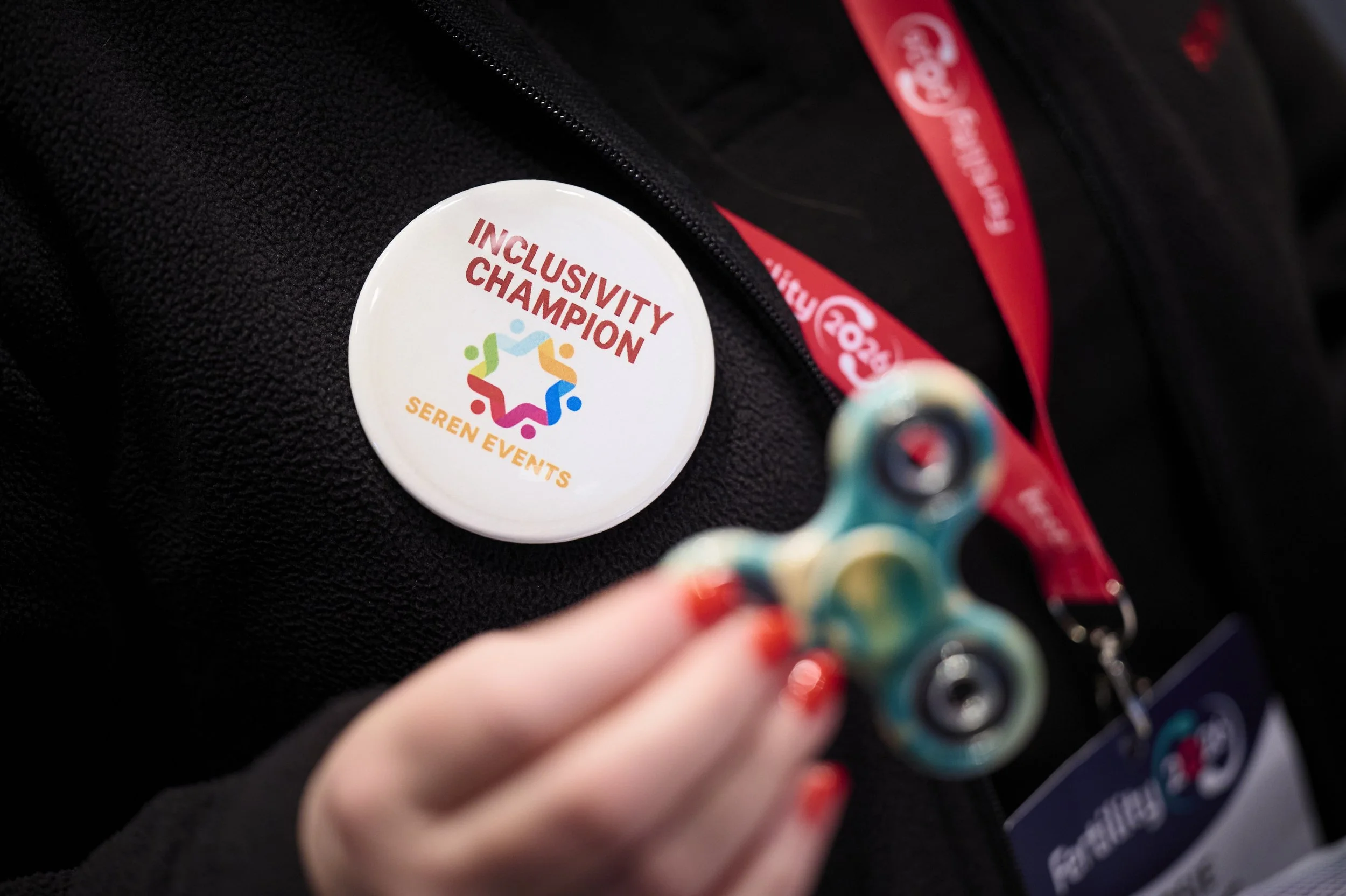
In 2025, the NatWest Audit Academy at the EICC became the first Welcome Brain Gold-Certified event in the UK. Such was the support for neurodiversity from the wider attendees that some neuroinclusive elements of the event have been incorporated back into NatWest’s corporate practices. Similarly, the Fertility Conference 2026 (also at EICC) was the first association event to get a gold certification through Welcome Brain. Both events received 100% positive feedback - showing that neuroinclusion improves the experience for both neurotypical and neurodivergent attendees.
Corporate event buyers are moving in the same direction. Industry research suggests major organisations are increasingly factoring neurodiversity provision into venue and event specifications.⁷ For venues competing for corporate and association business, that matters. Increasingly, buyers expect clear answers about neuroinclusion provision, and venues unable to provide them risk losing shortlist positions altogether.
The opportunity for UK venues and planners
The Academy of Management’s decision to move four years of conferences to Europe and Canada reflects a broader shift in how international organisations choose destinations and venues. Right now, the UK has a genuine opportunity to position itself as a leading destination for neuroinclusive international events.
For venues, the practical question is simple: can you clearly demonstrate neuroinclusive credentials to a planner or buyer who asks? Not through vague statements, but through recognised, independently verified standards that show delegates will be properly accommodated.
For event planners and PCOs, the question is whether neuroinclusion is embedded into venue selection and event design from the start, or whether it only gets discussed when a problem arises days before an event begins.
Both of those questions now have practical answers.
What to do next
For venues, Welcome Brain’s Neuroinclusive Venue Accreditation provides an independently assessed credential designed specifically for conference centres, hotels, and event spaces. It’s practical, proportionate, and tailored to the realities of the events industry rather than relying on generic accessibility frameworks.
For event planners, the Welcome Brain Neurodiversity in Events Checklist — developed alongside the Association of British Professional Conference Organisers (ABPCO) and the EICC — offers a practical framework for designing more accessible and inclusive events. It’s free, practical, and already used by event professionals internationally.
The international market is increasingly rewarding venues and destinations that get this right. The UK has everything it needs to become a leader in neuroinclusive events.
Sources
Doyle, A. (2026, May 13). Academy of Management Pulls 13,500-Person Conference Out of the U.S. Skift. https://skift.com/2026/05/13/academy-of-management-pulls-13500-person-conference-out-of-the-us/
VisitBritain. (2025). The benefits of providing an inclusive experience.https://www.visitbritain.org/business-advice/make-your-business-accessible-and-inclusive/visitengland-accessible-and-inclusive-3
VisitBritain. (2026). The value of the Purple Pound.https://www.visitbritain.org/business-advice/make-your-business-accessible-and-inclusive/discover-value-purple-pound
Liverpool City Region Destination Partnership. (2025, November 4). Purple Tuesday: Why Accessibility Matters More Than Ever For Liverpool City Region's Visitor Economy.https://liverpoolcityregiondp.com/2025/11/04/purple-tuesday-why-accessibility-matters-more-than-ever-for-liverpool-city-regions-visitor-economy/
Events Industry Council. (2025, November). The Future of Accessibility and Inclusion: Designing Events for Every Human Experience.https://news.eventscouncil.org/the-future-of-accessibility-and-inclusion-designing-events-for-every-human-experience/
Event Industry News. (2025, November 4). The Meetings Industry Association launches essential guidance on creating accessible events.https://www.eventindustrynews.com/news/the-meetings-industry-association-launches-essential-guidance-on-creating-accessible-events
Special Events. (2025, February 6). Part 3: Special Events State of the Industry 2024.https://www.specialevents.com/event-trends-styles/part-3-special-events-state-of-the-industry-2024
